What makes an environment where people grow and teams thrive?
You can usually tell when someone is engaged at work. They are the people who ask one more question before leaving a meeting, who spot a problem before it becomes urgent, who share an idea even though it is not technically their job to do so, and who notice that a teammate is struggling and step in without being asked.
None of these things appear on a job description.
Yet they can make a big difference to how a team works. That is why employee engagement at Qniverse is less about creating a list of activities and more about creating the environment in which people want to participate. Because people rarely give their best simply because they are told to. They do it when they feel there is something worth contributing to.
It starts with how people experience work
Ask someone what makes a good workplace, and they may talk about salary, flexibility, career growth or benefits. All of those matter. But spend enough time in any organisation and you notice something else. The everyday experience carries more weight than a policy document ever can. It is whether you can disagree with an idea without worrying about how it will be perceived. Whether someone listens when you raise a concern. Whether a good idea gets credit, even when it comes from the newest person in the room. If your manager trusts you enough to let you figure something out. These are small moments, but they tell people a lot about the culture around them.
At Qniverse, we want people to have the confidence to bring their perspectives, ask questions and challenge the usual way of doing things. The best idea does not always come from the most senior person in the room. Sometimes it comes from someone who has been thinking about a problem quietly for a few days. Sometimes it comes from a conversation between two teams that would not normally sit together. And sometimes, it starts with four simple words:
“What if we tried differently?”
A healthy culture needs room for that question.




Growth needs more than a career ladder
Career growth is often presented as a straight line: learn, get promoted, take on more responsibility. Real growth is rarely that tidy. Someone might become better at their role by working with a completely different team. Someone else might discover a strength after being given responsibility for something they had never done before. Another person might grow simply by having the space to make a decision, learn from it and try again.That is why we see growth at Qniverse as something broader than promotions or titles.
We encourage people to keep learning, take ownership and stretch themselves when opportunities arise. Sometimes that means stepping into unfamiliar territory or becoming better at something you already do. And sometimes, the most important growth happens when things do not go according to plan. A comfort zone is comfortable for a reason. But nothing much changes there. The right workplace gives people enough support to step outside it without feeling like they are stepping off a cliff.
Motivation is built in the small moments
Targets are useful. They tell us what needs to be achieved. They do not, on their own, make people care. Motivation often comes from something much closer to home: knowing that your effort has been noticed and that what you do has an effect on someone else. Consider a teammate who stays back to help solve a problem before a deadline. Or someone who finds a simpler way to handle a repetitive process. Or a colleague who takes the time to help a new team member find their feet.
These contributions may never appear in a quarterly report. They still matter.
Recognition does not always need to be elaborate. Sometimes, a genuine acknowledgement of good work is enough to tell someone, I saw what you did, and it mattered. That matters because appreciation reinforces more than morale. It tells people which behaviours the organisation values. Over time, those small signals shape culture.
Trust gives people a reason to take ownership
There is a subtle difference between responsibility and ownership. Responsibility says, this is your task. Ownership says, this is yours to figure out. The second requires trust. At Qniverse, we want people to have the space to use their judgement, creativity and experience rather than simply follow instructions. That does not mean leaving people to figure everything out alone. Good autonomy needs clarity, context and support. But once those are in place, constantly looking over someone’s shoulder does little to improve the work.
Trust changes the conversation. Instead of asking only, “What do I need to finish today?”, people begin to ask, “Is there a better way to do this?” That is a much more valuable question. It is also where engagement starts turning into ownership.
When people are engaged, work changes
The business case for employee engagement is fairly straightforward, but it is easy to reduce it to productivity numbers. The more interesting part is what happens before the numbers appear. People who feel connected to their work are more likely to speak up when something is not working. They are more willing to share ideas. They tend to collaborate rather than operate in silos. They are also more likely to care about the quality of the final outcome, not just whether their own part is complete. None of this means an engaged team works endlessly or says yes to everything.
In fact, healthy engagement can look like the opposite.
It can mean someone questioning an unnecessary process.
It can mean a team pushing back on an unrealistic deadline.
It can mean asking for help early rather than struggling quietly until a problem becomes bigger.
That is useful engagement.
The goal is not to make people work harder. It is to help people care enough to work better.
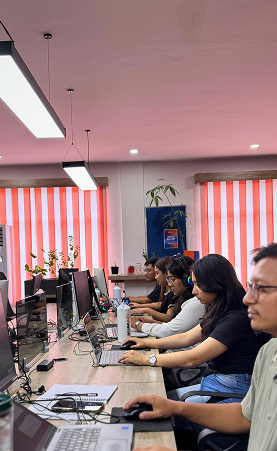



Culture lives between the meetings
Culture is easy to talk about in an employee handbook. It is much harder to see there. You see it in what happens between the lines of the formal stuff. A colleague checking in after a difficult conversation. A team celebrating a win that took weeks to achieve. Someone sharing credit instead of taking it. A manager listening instead of immediately solving. A person feeling comfortable saying, “I don’t know. Can we work it out together?” These moments rarely make it onto a culture presentation. They are culture.
At Qniverse, we want the everyday experience of work to feel human. That means creating space for connection, collaboration, feedback, recognition and, yes, a little laughter along the way. Because people are people before they are job titles. And a workplace that remembers that tends to build stronger relationships.
Give people reasons to stay
Retention is often discussed as if it were a number that belongs in a business review. For an employee, staying is a personal decision. People stay when they can imagine themselves becoming better where they are. They stay when they trust the people around them. When their contribution is recognised. When there are opportunities ahead. When they feel respected. When the workplace gives them a sense of belonging rather than simply somewhere to log in every morning.
Of course, no organisation can promise every employee everything they will ever want. People change. Priorities change. Careers change. But an organisation can create an environment where good people have compelling reasons to continue the journey. That is what we want to build at Qniverse. A workplace people do not feel they have to stay in, but one they have reasons to stay in.
Strong roots make room for growth
There is a reason the strongest trees are often the ones with roots you cannot see. The visible growth is only part of the story. The same is true of an organisation. The projects, products and milestones people see from the outside is just the tip of an iceberg. Underlies the trust between colleagues, shared experiences, learning, encouragement and a sense that individual contributions matter. Those are the roots.
At Qniverse, employee engagement is about strengthening them every day. We want people to feel valued enough to contribute, trusted enough to take ownership and supported enough to keep growing. Because growth does not stop with the individual. One person learning can help a team learn. One good idea can improve how everyone works. One stronger connection can make collaboration easier across an entire group. That is how individual growth becomes collective progress. And perhaps that is the simplest way to describe the culture we are building at Qniverse